
European growth capital
Breakneck and Abundance: Learning to Build Without Learning to Bulldoze
Read together, Dan Wang's Breakneck and Ezra Klein and Derek Thompson's Abundance ask why rich societies have become so poor at turning ambition into physical reality — and what boards, investors and Europe should take from the answer.
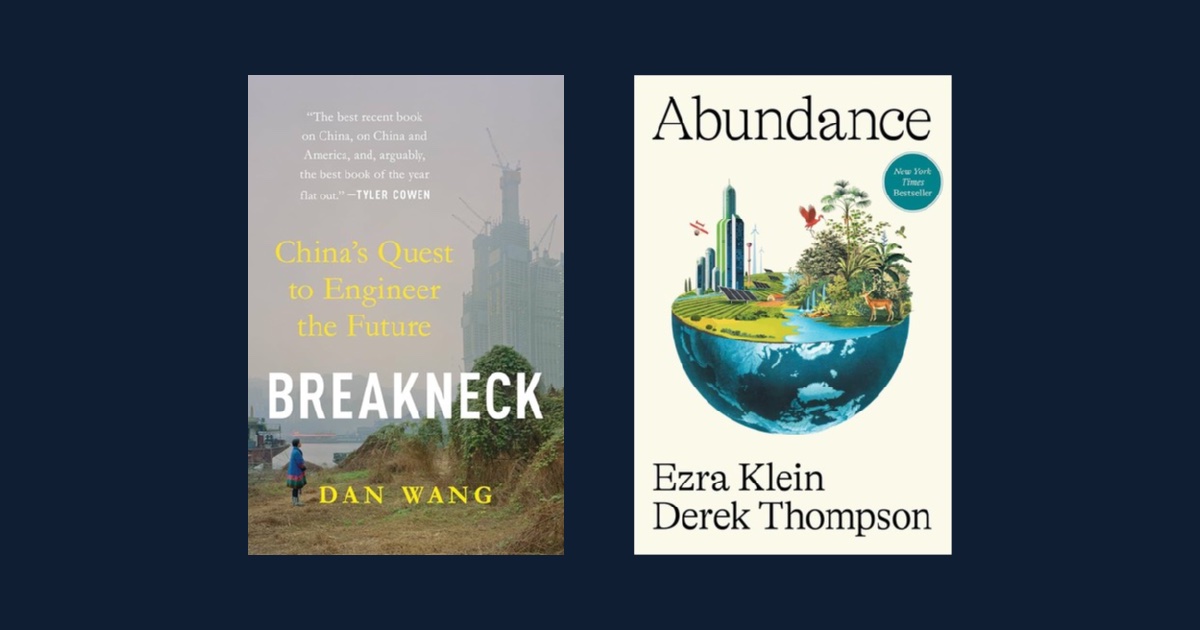
The most useful way to read Dan Wang’s Breakneck and Ezra Klein and Derek Thompson’s Abundance is together.
Both confront a question that advanced economies have spent too long avoiding: why have societies with extraordinary wealth, knowledge and technology become so poor at turning collective ambition into physical reality?
They approach it from opposite directions.
The engineering state and the lawyerly society
Wang describes China as an “engineering state” and America as a “lawyerly society”. China’s governing instinct is to build, reorganise and intervene. America’s is to argue, regulate, litigate and constrain. One reaches for the sledgehammer; the other for the gavel.
It is an arresting distinction because it cuts across the conventional discussion of China. Wang is less interested in whether an economy is nominally capitalist or communist than in the habits its institutions have developed. Which professions hold authority? What kinds of problems does the state believe it can solve? What does it actually know how to do?
China has spent decades developing the capacity to execute large physical projects at extraordinary speed. It has built cities, transport networks, power systems, ports and manufacturing clusters on a scale that can be difficult to comprehend from Europe or the United States.
It has also applied the same engineering mentality to society itself, often with brutal consequences. The strength and the danger arise from the same conviction: that sufficiently determined people, backed by the state, can redesign almost anything.
Where Abundance begins
Abundance begins from the other side of the problem.
Klein and Thompson examine why American liberalism has become much better at stating desirable outcomes than producing them. It wants affordable housing, clean energy, public transport, healthcare capacity and scientific progress. Yet the systems created to protect communities, the environment and individual rights have accumulated into a formidable architecture of delay.
Governments promise more while operating institutions designed to prevent change. Projects acquire years of consultations, reviews, objections and litigation before anyone pours concrete. The intentions may be progressive; the material consequences often are not.
This is where the books illuminate one another.
Abundance is right that societies cannot distribute what they refuse to produce. Housing policy without housing, climate policy without transmission lines and industrial policy without factories eventually become exercises in rationing scarcity.
But Breakneck supplies the necessary warning. Capacity without constraint is not abundance. It can mean waste, displacement, coercion and catastrophic experiments conducted on people who have little power to object.
China’s ability to build is impressive. Its willingness to bulldoze opposition is not something democracies should import.
The choice, therefore, is not between Chinese speed and Western paralysis. It is whether democratic societies can recover the ability to act without abandoning the rights, safeguards and institutional legitimacy that distinguish them from an engineering state.
The physical economy
Both books are strongest when discussing the physical economy.
Manufacturing is not simply a matter of placing a factory on a map. It is a cumulative system of suppliers, technicians, foremen, process engineers, tooling, logistics, customers and repeated production learning. Once that system disappears, it cannot be recreated through a ministerial announcement or a tariff schedule.
This has direct implications for boards and investors. A business may own valuable intellectual property and still lack control over the capabilities needed to commercialise it.
Europe may retain the laboratory and the patent. Someone else acquires the factory, the learning curve, the supplier ecosystem and, eventually, much of the bargaining power.
That does not mean every product should be manufactured domestically. Autarky would be ruinously expensive and, in many industries, impossible.
The serious question is which capabilities are strategically important enough to control, which can be secured through trusted partners, and which should remain part of an open global market.
That requires a more granular conversation than the usual demand to “reshore manufacturing”. Defence, critical infrastructure, medical countermeasures and parts of the energy system plainly raise questions of national resilience. Other sectors may depend more on diversified supply, long-term contracts or production partnerships than on local ownership.
Tariffs may protect an existing factory, but they cannot recreate supplier density, technical skills or production knowledge. Subsidies can purchase equipment, but they cannot manufacture an industrial culture. Industrial policy without execution capacity is theatre with better slide decks.
The relevant question for boardrooms and policymakers alike is not whether an organisation has an industrial strategy. It is whether the underlying system can execute it.
Does it have access to suitable energy, capital, equipment and skills? Can it obtain permits within a commercially meaningful timeframe? Are there suppliers capable of meeting its quality and volume requirements? Is procurement helping to create a market, or merely favouring the lowest immediate price? Which part of the value chain contains the scarce knowledge and bargaining power?
The limits of both arguments
Neither book completely escapes the limitations of its central argument.
Wang’s distinction between engineers and lawyers is revealing, but it can become too neat. China has its own bureaucracy, legal complexity and spectacular misallocation of capital. Evergrande is hardly evidence of an engineering state operating with perfect technical rationality.
America, meanwhile, remains capable of building global technology companies, advanced defence systems and scientific platforms of enormous sophistication. Organising professions influence national behaviour, but they do not entirely determine it.
Abundance can also make obstruction sound more technocratic than political. Projects are not delayed only because systems are badly designed. Scarcity often benefits existing property owners, regulated incumbents and established organisations with the resources to navigate complexity. Some disputes reflect genuine conflicts over cost, risk and distribution rather than a simple failure to appreciate the virtues of building.
The books nevertheless identify something important: institutional systems tend to reproduce the behaviours they were designed to encourage.
China’s state is structured to mobilise resources and therefore continues to build, even when building more is unnecessary or destructive. Western institutions were designed to restrain arbitrary power and protect affected groups, and therefore continue adding safeguards even when their cumulative result is immobility.
Europe’s mausoleum — and its opportunity
Europe does not fit cleanly into either model.
Wang is particularly damning about it:
“Europeans have a sense of optimism only about the past, stuck in their mausoleum economy because they are too sniffy to embrace American or Chinese practises.”
“Mausoleum economy” is a brutal phrase. It lands because it captures something recognisable: a continent sometimes more comfortable preserving the achievements of the past than taking the risks required to shape the future.
Europe has made itself expensive to build in, difficult to scale across and frustratingly slow to approve new infrastructure. It has allowed high energy costs, fragmented capital markets and procedural complexity to weaken industries in which it once held formidable advantages.
Its regulatory reflex can become a substitute for industrial strategy. Europe is often quicker to define the rules for an emerging market than to create the conditions in which European companies can lead it.
But Wang’s dismissal is too complete.
Europe is not an industrial museum. It remains exceptionally strong in aerospace, pharmaceuticals, advanced machinery, energy technology, automotive engineering, chemicals, precision manufacturing and scientific research. Its engineers are excellent. Its universities remain at the forefront. Its infrastructure, workforce and public institutions are stronger than much of the current commentary suggests.
The problem is not that the underlying capabilities have disappeared. It is that they are too often fragmented, undercapitalised and poorly connected to procurement, production and scale.
Research sits apart from the scale-up capital needed to commercialise it. Climate ambition sits apart from permitting reform. Industrial policy sits apart from energy policy. Regulation is developed without sufficient consideration of implementation. National markets remain too fragmented for companies that need continental scale.
That distinction matters.
A continent without capabilities would face managed decline. A continent whose capabilities are badly organised faces a difficult but solvable institutional problem.
Europe may, in fact, have the most interesting opportunity of the three systems.
It does not need to reproduce China’s coercive engineering state. Nor should it accept the American combination of technological dynamism, institutional vetoes and extreme inequality as the only democratic alternative.
It can attempt something more difficult: an economy that builds at speed while retaining public legitimacy, legal restraint and high social standards.
Regulation would remain part of that model, but it would need to become more predictable, proportionate and technically informed. Permitting would have deadlines. Capital markets would make it easier to fund scale rather than merely invention. Public procurement would help create customers for emerging technologies. Governments would be more selective about the capabilities they genuinely need to secure, and more disciplined about delivering them.
This is more demanding than announcing a subsidy programme or imposing a tariff. It requires governments, companies and investors to understand production as a system rather than a collection of isolated factories.
What boards should take from this
For directors, the practical lesson from both books is straightforward. Strategy cannot stop at aspiration. Boards need to understand what their organisations are physically capable of delivering, which dependencies matter and where execution knowledge actually resides.
Breakneck explains the power and danger of a society organised around engineers. Abundance explains the frustration of societies that have allowed legitimate constraint to harden into institutional paralysis.
The answer is not to choose between them.
The challenge is to build without bulldozing: to recover speed, ambition and physical competence while preserving the rights and legitimacy that make progress worth having.
Europe is not there yet. Neither is America. China demonstrates what execution capacity can achieve, but also why capacity alone is not enough.
The countries that succeed will be those that combine engineering ambition, democratic restraint and institutional competence. Europe still possesses all three ingredients. Its problem is not that it has lost them, but that its institutions have made change appear more dangerous than stagnation.
Yet the risk of not changing is greater still.
For all Europe’s shortcomings, it remains where I would choose to live. That is telling in itself. Europe’s task is not to discard the qualities that make it attractive, but to recover the confidence, self-belief and capability to build while preserving them.
Distribution list
Be told when a new essay is published
Join the distribution list for occasional notes on governance, boards, AI, healthcare and growth capital. No marketing — just new essays.