
Chairmanship and board effectiveness
Inside the Box: The Discipline of Limits
David Epstein's Inside the Box argues that constraints, not freedom, produce our best work. For boards, it reframes budgets, deadlines and scope as design choices rather than mere controls.
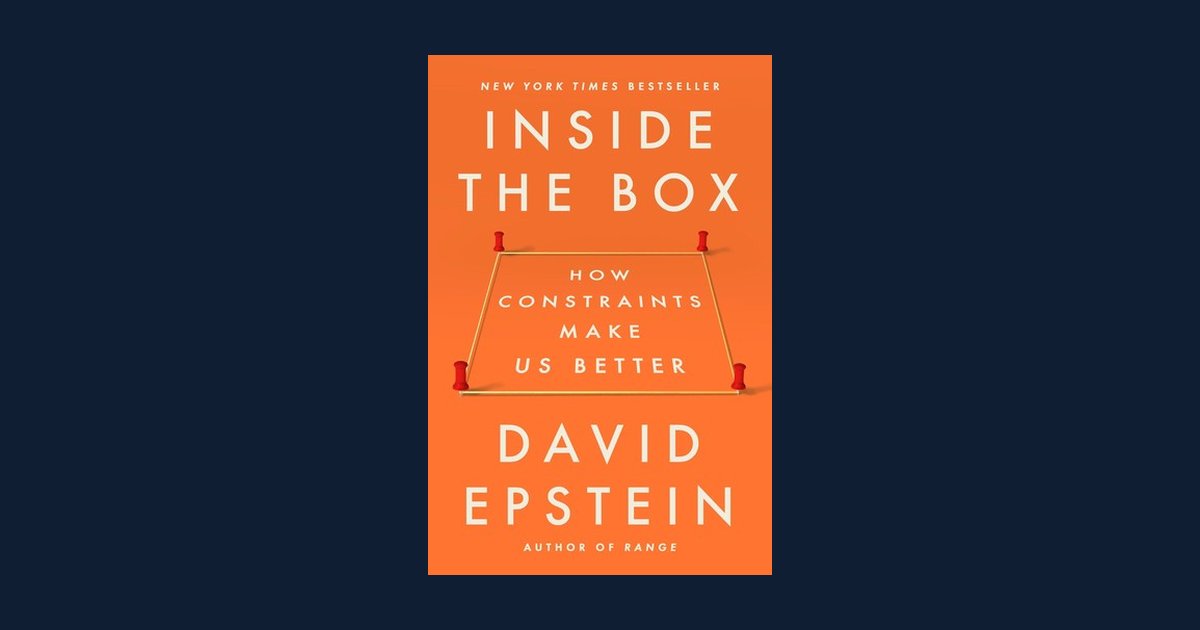
David Epstein’s Range is one of my favourite books from a few years ago. Its argument, that breadth and interdisciplinary thinking drive much of real innovation, matches almost everything I have seen in companies, in innovation and even in the boardroom.
Inside the Box looks at first as though it argues the opposite. Range is about widening your experience. This book is about narrowing your options. In fact the two fit together: one is about where good ideas come from, the other about what forces them to appear.
Freedom is overrated
Epstein’s claim is that total freedom, in his words as quoted by Publishers Weekly, “is the enemy of creativity, and constraint its companion.”
When we have unlimited options, we fall back on what we already know. A constraint blocks the familiar path and forces us to find another. Dr Seuss wrote Green Eggs and Ham on a bet that he could not write a book using only fifty different words. The limit did not weaken the book. It produced its rhythm and its charm.
General Magic and the box that came first
His best business example is General Magic, the 1990s company that tried to invent the smartphone. It had extraordinary talent and plenty of money, but no real limit on time, scope or cost. Projects grew without end, and the company failed.
Tony Fadell, one of its alumni, took the opposite lesson to Apple and later Nest. He started with the physical box and made the features fit inside it. The constraint forced the hard choices about what mattered.
Frugal innovation makes the same point. NASA’s LCROSS mission was given roughly half the budget and time its team wanted. They borrowed off-the-shelf sensors and went on to confirm water on the Moon.
The habit of adding
The idea I find most useful is additive bias. Faced with a problem, people instinctively add a feature, a step, a person or a process. They rarely think to subtract. Epstein’s remedy is a “subtraction audit”.
This sits neatly alongside Jon McNeill’s The Algorithm, which argues that the best part is the part you remove. Two very different books reach the same conclusion.
It matters for AI too. When producing something costs almost nothing, the scarce resource is deciding what is worth producing. Without a constraint, AI simply generates more.
The limits of the argument
Some critics have suggested the core science could have been a long article, and Epstein does at times oversell his thesis. Some teams fail because they are under-resourced, not over-indulged.
There is a more serious risk. “Constraints breed creativity” can easily become a polite way of saying “we are not going to fund this properly”, and teams can tell the difference.
Focus or starvation
Constraints are design tools, not just controls. A fixed budget, a hard deadline or a narrow scope can be what produces focus. Boards set these limits all the time, usually for financial reasons, and rarely think of them as part of how the work is designed.
The judgement call is telling a constraint that sharpens a team from one that starves it. In medtech and life sciences that matters enormously. Cutting a clinical programme’s budget by a third will not produce NASA’s LCROSS. Giving a product team a hard launch window and a short list of must-have features might.
So the useful question for a board is not only how much to spend, but which limit would force a team to make its hardest choice now rather than later, and whether a given limit is there to focus the work or simply to save money.
Epstein will not tell a board where to draw the line. But he gives directors a better reason to draw it deliberately.
Distribution list
Be told when a new essay is published
Join the distribution list for occasional notes on governance, boards, AI, healthcare and growth capital. No marketing — just new essays.