
Chairmanship and board effectiveness
Incorruptible: Culture Follows Structure
Eric Ries's Incorruptible argues that good companies go bad because of how they are owned and governed, not because of who runs them. His diagnosis of short-termism is right. His cure is harder to apply.
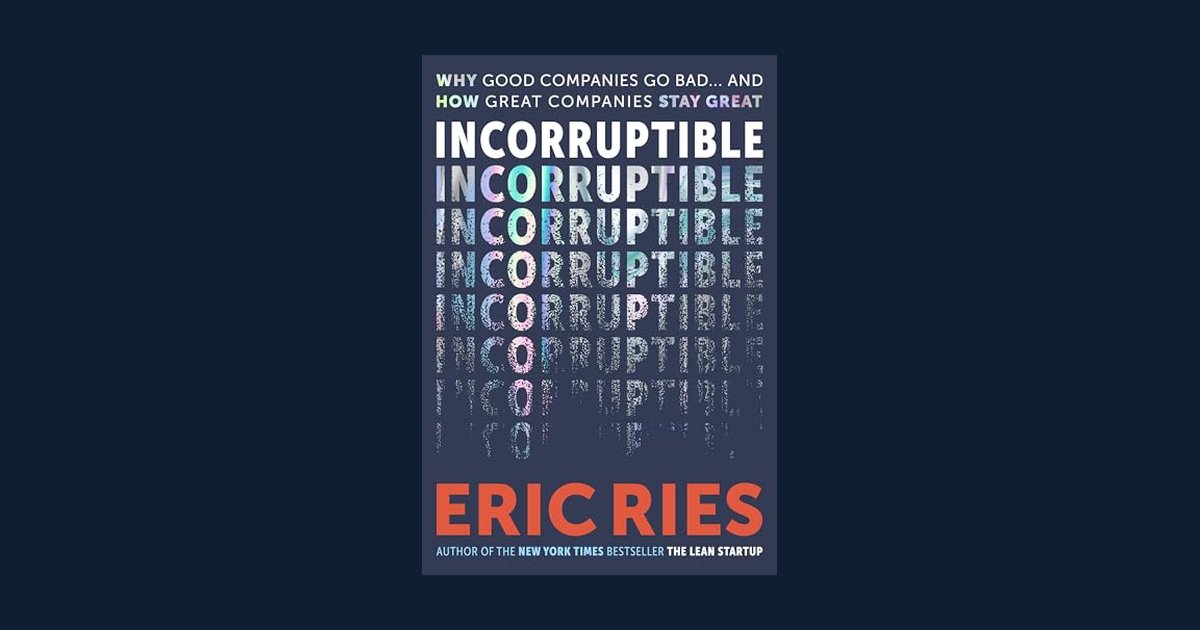
Most corporate failures are told as stories about people: a greedy chief executive, a captured board, a culture that quietly went rotten.
Eric Ries’s Incorruptible asks a better question. Why do so many good companies, run by decent people, end up somewhere none of them intended?
Financial gravity
His answer is structural, and that is what makes the book useful.
Companies rarely decay because their leaders become villains. They decay because ownership, incentives, charters and decision rights push everyone in the same direction, slowly and almost invisibly. Ries calls this “financial gravity”. The more successful a company becomes, the stronger the pull towards short-term extraction.
Gravity does not need anyone to give an order. Executives anticipate what investors will want and act on it before anyone asks. Nobody instructs them to. The structure does. And in Ries’s sense of corruption, making money without creating value, most of it is perfectly legal.
From mission to shareholder primacy, and back
Mission-based companies were far more common in the 1950s and 1960s. From the 1970s, the view that a company exists to maximise returns to shareholders took hold, and it is now written into almost every set of articles we read.
Ries’s alternative is not a softer culture but a different structure: companies whose mission is locked in by who owns and controls them. Novo Nordisk, Bosch and Zeiss are controlled by foundations. John Lewis is owned in trust for its employees. Costco has held the price of its hot dog since 1985, after its founder’s earlier company, FedMart, was taken over by investors and closed.
His most useful point is that governance can be designed, not just inherited. Very few boards ever design theirs.
Where Ries is right: short-termism
On the diagnosis, I agree with him. Public markets have become structurally short-term, and listed boards feel it every quarter.
The evidence has been there for years. In a well-known survey of US finance chiefs, around four in five said they would give up long-term value to hit a quarterly earnings target. Holding periods have shortened, ownership has fragmented, and much of the capital that stays is passive. The UK’s Kay Review identified the same problem in 2012, and dropping mandatory quarterly reporting did little to change the culture.
The consequences are visible: research cut to protect a margin, buybacks preferred to investment, and good companies staying private, or leaving London, rather than manage to the next set of numbers. In healthcare and life sciences, where a product can take a decade to reach patients, the mismatch is especially damaging. It is the same problem behind my piece on Mansion House.
Ries is describing a problem in how capital is owned, not just how companies are run.
The uncomfortable part for non-executives
Ries is not kind to non-executive directors. In a shareholder-primacy structure, he sees too many of us as rubber stamps: approving the plan and leaving the mission to look after itself.
That is not entirely fair. But it is not entirely wrong either.
He also raises a question that will become more pressing: when the founders who hold a mission-driven company together retire or become the problem, what happens to the mission?
The limits of the argument
The diagnosis is stronger than the cure. At over 400 pages the book is long, the tone can turn missionary, and the practical advice arrives late.
More importantly, structure is not everything. A mission lock can protect a good company from short-term owners. It can also protect a poorly run one from the consequences of its own decisions. Even Novo Nordisk, his anchor example, has had a turbulent couple of years, with its controlling foundation stepping in to reshape the board.
Ries also has a stake in the argument. He founded the Long-Term Stock Exchange and advises companies on their governance.
Structure before values
Most investor-backed boards will not be converting to foundation ownership. In private equity, the hold period and the exit are the structure.
The lesson still transfers. Values statements and purpose workshops are weak against incentives. The useful questions are structural:
- What does our incentive plan actually reward, and over what time horizon?
- Which metric has quietly become the goal?
- When mission and short-term returns conflict, who holds the decision right?
- What happens to the mission at exit?
The question is not whether a company has good values. It is whether its structure gives those values any chance of surviving success.
Distribution list
Be told when a new essay is published
Join the distribution list for occasional notes on governance, boards, AI, healthcare and growth capital. No marketing — just new essays.